Tuesday, August 15, 2023


Friday, July 28, 2023
Friday, September 30, 2022
Sunday, August 14, 2022
We are The Movement Of Coherence

“This difficult work of diplomacy, often unglamorous and contentious, could become a highly respected and influential form of leadership. If such roles are given recognition and support, a network of movement diplomats and diplomatic training programs could help a systemic movement overcome barriers of language, class, region, and outdated “issue-silos”. It would be through the work of these diplomats that spaces for engaged dialogue would be developed, multiplied, and enhanced. Movement diplomats could be a key to developing coherence while avoiding the evolution of stultifying movement hierarchies.”
From “Dawn of the Cosmopolitan The Hope of a Global Citizens Movement”
Orion Kriegman
Sunday, August 01, 2021
Why do we pursue improving impact investing?
Wednesday, May 26, 2021
informing the blind spots in our economic models - through thinking about new ways to perceive and differentiate.
"The ferment Heisenberg caused in physics is now leading to efforts by Wheeler, Everett, Capra and Wigner and a host of audacious young physicists to write the observer back into the equation - an overdue recognition of the most basic of the "hard" sciences that, in a very real sense, reality is what we pay attention to. In fact, the humanoid is a perceiving/differentiating device of limited range inevitably distorts the visioning of the totality. Indeed perhaps original sin is nothing more than differentiating, out of which grows such communal grief. Out of more holistic insights we may discover a different view of probability theory, rooted in the understanding that “randomness” and “disorder” are only measures of human ignorance. While of peripheral vision, by the drive of “probabilities,” was an imaginative leap, perhaps we may also embrace the possibility that those “probabilities” actually exist, even though we are not paying attention to them, as the many worlds-interpretation in quantum physics suggests.” ~ Hazel Henderson from her book 1976 book "Creating Alternative Futures, the End of Economics"


Saturday, January 30, 2021
Toward a new model framework for finance to build a common good capitalism
Sunday, January 17, 2021
first draft: From Charting A New Course For Impact Investing, To Sailing to New Seas Only Imagined

[this is a rough draft, please pardon the typos]
MONEY MEANING AND MARKETS
Now that nearly 18 moons has passed since Ethical Markets published
this piece, which I co-wrote with Nick Sramek, based on our share visions and experiences, his as a knowledge officer at a thin tank guiding pensions and family offices and mine a nearly three decade passion for sustainable development, green economy and ethical investing.
After the article has opened up so many doors for us, and strengthened the convictions I had about the nature of evolving finance, and while Nick and I had complementary visions, my experience in creating this piece is as if it could been either of ours, and both of ours at the same time. And neither of us really thought we invented any ideas in the article, yet we were simply looking to assess the state of affairs of a movement over the last decade in anticipation of the 10th anniversary of the conference, as a human created demarcation point to pause, and reflect "what will the next decade be like?" We felt that to articulate and corroborate a shared understanding of the thought leadership in the field, we could increase the diffusions of innovation of thought theory and practice more rapidly, thus bringing about the desired futures more readily and rapidly.
The article somewhat draws from the number of years I wrote about my experiences at the Social Capital Markets Conferences (SOCAP) and the people who inspired the movement, and me, the most. The conference is the opening of the article, and the setting is where the conference is held, in golden October sunshine overseeing sailboats and steamships on San Francisco Bay at Fort Mason with an ever present view of the incredible international orange paint on golden gate bridge and the vast redwoods on the other side.
There’s an essential arc in the article, a through line, which is drawn like a golden thread through some of the minds who architected the foundational layers of the new economy and responsible investing movement in the 60's, 70's and '80's and some of the earliest social entrepreneurs and innovators in finance which led to the current forms of ESG and Impact Investing. Yet, as systems grow and evolve, so do it's ideas, and as ideas evolve, so do systems. We cannot create something we cannot imagine. Nor can we see the butterfly in the caterpillar, yet it is encoded within. Similarly each of the people mentioned in the bullet points are calling for something more comprehensive, sensitive, complex, nuanced, contextual, effective or systemic. All based on new ideas and paradigms. In many ways these ideas are the foundational architecture of the new economy movement. There are a range of shifts going on the spectrum of systems, such as:
- From Impact Investing to Integrated Finance “The Clean Money Revolution” – Joel Solomon
- From Sustainability to Regenerative Economics “A Finer Future”- Hunter Lovins, John Fullerton et al
- From Economism to Earth Systems Science – Mapping the Transition to the Solar Age Hazel Henderson 2014
- From Reductionist Thinking to Systems Thinking Biomimicry for Finance 2012 Statement for Transforming Finance based on Ethics and Life’s Principles Hazel Henderson, Jeanine Benyus and others at Ethical Biomimicry Finance
- From Financial Capitalism to Mutual Impact and Deep Economy Jed Emerson – The Purpose of Capital
- From Ego-System to Ecosystem Economies Otto Sharmer Leading from the Emerging Future
- From Extractive Businesses to Regenerative Business Carol Sanford Regenerative Business
- From Conventional Capitalism to Common Good Capitalism Terry Mollner, Common Good Capitalism
- From Billions To Trillions In March 2018 the concept paper From Billions to Trillions: How a transformative approach to collaboration and finance supports citizens, governments, corporations, and civil society to share the burdens and the benefits of solving wicked problems
- From Private Banks to Public Banking Public Banking Institute
- From the New Deal to the New Grand Strategy and the New Green Deal “New Grand Strategy” Patrick Doherty, Puck Mykelby and Joel Makower
The essential pull in this article is north star of multigenerational human prosperity through rethinking the pathways and means to evolve markets and money systems. Each of these thinkers and social entrepreneurs sought to meet the growing volatility, uncertainty, complexity and ambiguity in our civilization with more comprehensive systems approach, often born out of the context of their personal experiences. Each of them point toward an increasingly complex form of managing our economy and the store and exchange of value. And essentially we're going through a phase shift from one form of civilization to another. Some are calling this the new axial age.
Not unlike the Copernican Age from waking up to the fact that we orbit a star, or the rennaissance, yet this one feels like a shift toward something deeper, toward the collective interior of thought, and ideation. We are challenged to the core in our belief systems, perhaps because it's not about beliefs, but about meeting the world for what it is now, as what we believe is from what was, not is.
So if our institutions were based on the information processing limits of the technology of their times, then let's evolve the culture of decisionmaking with a broadening of stakeholders, and the contextual data for each and every dimension of our community of life. We can then shift, from reductionist monetary systems based on a rare commodity such as gold, or shells, often associated with self limiting ego oriented cultures, silo thinking and institutional regimens based on earlier modes of civilization toward a more comprehensive systems approach for managing the affairs of our communities and bioregions. From walls to ways to relate.
The notion of evolving economic development, or the practice of evaluating myriad economic development paradigms is an important one for us to have better results from our business clusters and governance systems. We will be able to enhance the value drawn from innovative entreprenuership and business clusters. When we see a larger context from our enterprises, and adding additional bonus points of environmental, social and cultural regeneration, we have a longer view to work from. To the lives of our kids, and their grandkids. And theirs. We can then have a clearer sense of the path ahead, and where the path we are walking are walked by others, on the same ground in a different time.
We can then be focused on the full spectrum of what is going on around us in our places now, incorporating Environment Social and Governance Factors into our planning and decisionmaking for harmony and mutual prosperity for each other and our planet. The various regions on our planet, which have a range of climate, plant and animal patterns - or classification of types of bioregions in frames such as rainforest to desert to coastal tundra, or mediteranean to nordic or tropical to alpine. With these patterns of climate and resource contexts - we see emerging patterns and challenges. For example cities in desert regions have different infrastructure challenges than cities in subtropical cities adjacent to rainforests. Thus the solutions and projects will evolve in bioregional patterns, and also you can see the pattern of agriculture has patterns that map across the globe depending on climate.
We saw this context of place based, full spectrum accounting vision for human activity as a north star, inspired in part based on the patterns and strategies of life over the last 4.3 billion years. I led a series of conversations and panel discussions at the SOCAP Conference in 2014, 2015 and 2016 under the banner of "biomimicry for finance" and the last panel had a bioregional twist. We titled the event "Building an Economic Ecosystem Like 3D Chess - Local, Regional and Systemic" and that is where we began seeing bioregional thinking really enter our thinking, based on the many years of work of scientists in the field.
More recently, OneEarth has created a bioregional map for planet earth. Imagine this as a pattern to organize our cities and their related supply chains. Wouldn't it help us shapeshift agriculture, infrastructure, economic decisionmaking, and long term urban planning with a new set of ingredients?
Were we to allow finance to simply evolve to serve the 21st century needs for what I feel are the 5 R's relationship, resilience, regeneration, reconciliation, and reverence, in partnership with the community of all life. This would turn finance into a better tool in service to our humanity, to meet the needs of current and future generations at the same time, by simply waking up out of our dream of separation from life into seeing our belonging, each of us in community with the whole of humanity and our massive inheritance of the bounty of earth
“Charting a New Course For Impact Investing”
We feel it is essential that we imagine better ways to approach questions such as:
- How economic development be evolved by adopting systems approaches? And shifting economic behavior to the limits of the biosphere in each bioregion, and optimizations for innovation and efficiency of energy use (along the lines that a more efficient form of life often has more longevity)
- How can impact investing (also known as Socially Responsible Investing, ESG, Ethical Investing, triple bottom line, SDG’s etc.) evolve to shift the underlying economic paradigm in a community of practice, or industry? How can we collecitvely incorporate living systems to improve our business models and theories of change?
- How can we build on the successes of leaders for decades, and help bring our collective visions into form - there are a number of areas where our model of operation is evolving "from -> to” and in some ways the cognitive leaps feel logarithmically more complex than the previous stage. Please see items below.
- How can we all come to a better shared understanding the aforementioned themes of economy, longevity and progress in far simpler terms? We know our place, we want to live in tune with the gifts in life. We all want to and to be feel more love and connection, connected to our beloved families and friends, have lives full of prosperity pleasure and meaning filled lives. We can all identify with these fundamental human values - and also to have clean air, healthy tasty food, and enjoying the ups and downs in life in the company of those who we love the most. These are among fundamental human traits, and as we are part of the web of life, then it's clear that somehow we are all part of each other’s living experience in some way, or at least you are connected to anyone who has read this far in the article.
Tuesday, December 08, 2020
“EVOLVING MARKETS IN METAPHYSICAL RECONSTRUCTION”-By Hazel Henderson
Here's piece from my friend Hazel who outlines a rather comprehensive cognitive reset necessary to bring about new economic activity, with insights and recommended pathways for a number of key sectors for civilization to thrive.
“EVOLVING MARKETS IN METAPHYSICAL RECONSTRUCTION”-By Hazel Henderson
The earliest markets for metaphysical reconstruction evolved continually from changing belief systems, religions, creation stories, cultural fashions, and later from science fiction, futures forecasting scenarios. These changing styles of being and behaving are ubiquitously and profitably expressed in the arts: paintings, poetry, fiction books, music, dance and theatrical performances. These markets flourish in all Information-based societies and now dominate all other forms of globalization. In our Information Age value is shifting from material production and trading things you can drop on your foot to digital assets: intellectual property, patents, brands, recipes and reputational “goodwill”, which accountants are still learning to measure. Most mature industrial societies have made the shift and up to 80% of their GDP accounts are for these intangibles. For examples: the value of Coca Cola’s caramel-colored sugar water recipe is carried on their books as a primary asset of up to $70 billion, while Donald Trump’s real estate company morphed years ago into a “branding” operation for hotels, beef, vodka and other products, with others building and owning the actual real estate and producing the products.
Stock markets based on bouncing fiat currencies are ever more at risk of “flash crashes” and crises, as more investors are trading digital assets electronically on private liquidity networks and using cryptocurrencies with no tethers to the real world, as I reported in “Money, is Not Wealth: Fiats v. Cryptos“. Accountants now measure six different forms of capital: finance, built factories and facilities, intellectual capital, social capital, human capital and natural capital, and measure the performance of corporations as the extent to which they enhance or degrade all these six forms, (my visual “Shifting forms of valuation”). GDP is a simple cash flow statement of goods and services transacted in money, measures all public debts, but not the investments they create: public goods (education, municipal services, R& D), infrastructure and other assets, simply because GDP does not have an asset account, as in formal double-entry book-keeping. Education is classified as “consumption”, even though it is the most important investment all societies make in the health and competence of their future citizens. All these shifting forms of metaphysical re-construction are often referred to as “paradigm shifts’, as in Thomas Kuhn’s “The Structure of Scientific Revolutions”, (1962). They are creating thriving new markets for consulting firms, marketers and internet platforms re-intermediating our complex societies in new ways. For full disclosure, Ethical Markets Media Certified B. Corporation, which I founded in 2004, is such a digital asset-based enterprise, creating intellectual products based on futures research and scenario-building of possible pathways of technological and cultural evolution.
These often highly lucrative markets for such metaphysical reconstruction are the necessary foundation for new infrastructure and plumbing for the new technologies and economic activities. All human societies are transitioning from the fossilized Industrial Era of the past 300 years to the cleaner, greener, knowledge-richer and more equitable Solar Age I continue to track and document since my “The Politics of the Solar Age”, (1981,1988), now in 800 libraries in 20 languages. Instead of digging in the Earth to produce our goods, we are learning from plants’ photosynthesis how to use the sun’s free photons which have always powered our planet and provide all our food, shelter and very survival.
These tectonic social transitions feedback to expand human cognitive skills and widen our mental and emotional horizons, as described by Harvard-based systems synthesizer, Prof. Joseph Henrich in his monumental “The WEIRDEST People in the World”, (2020). Henrich ransacks human history, religions, cultural styles and economies and focuses on this kind of human cultural evolution which outpaces the slower evolutionary process described by Darwin as evolution by natural selection under changing environmental conditions. Henrich rightly criticizes psychology and economics for their scholars’ cookie-cutter models of human behavior and preferences. These practitioners are blind participants in this same cohort of “Western Educated, Industrialized, Rich and Democratic“ (WEIRD) people acculturated during the Westernized Enlightenment-driven Industrial Revolution. This herculean book is still engrossing me as Henrich focuses on the role of reading and literacy and how these skills actually change our physical brains, expanding our behavioral repertoire and thickening our corpus callosa!
I was stunned, since many neuroscientist I know have commented on how this bridge of tissue linking the left and right hemisphere of our brains: the corpus callosum, affects our cognitive abilities. Some had told me that my own corpus callosum was probably much expanded, as a lifelong author and bookworm! Henrich traces this rapid widening of literacy as stemming from Martin Luther in Wittenberg, Germany in 1517, who opposed the Catholic bishops’ monopolizing access to their Holy Bible and selling of “indulgences” to speed their elites into heaven. Luther demanded that all people be allowed to read the Bible for themselves and that they be taught to read. Thus, Protestant literacy spread with the speed of historic means of human interaction, mostly by proximity to the town of Wittenberg, and people began to acquire expensive hand-written Bibles and learn to read them.
A new market was created for cheaper Bibles, filled by an enterprising printer, Johannese Gutenberg, who created the first movable type printing press, and began producing cheap Bibles. Thus, Henrich describes how literacy went viral and public schools spread across Germany, Switzerland, the Netherlands and Britain, seeding the Enlightenment scholarship of Adam Smith, David Hume and others in Scotland. He described the WEIRD cohort of the global population as beneficiaries of this literacy and educational transformation. They wrongly assume such human behavioral traits as the universal model of human nature. Instead they miss the tremendous variation in most of the other cultures and societies on this planet, which led to all the mistakes of GDP-led globalization, mal-development, poverty, nativist backlashes and populism we see today.
One assumption of Henrich and of Kurt Anderson in his “Fantasyland: How America Went Haywire“ (2017) is that they both take adult literacy rates in the USA in 2015 as given at 100%, whereas more recent surveys by the US Census and the National Institute for Literacy estimate that 32 million adult Americans are still unable to read. Much of this is due to earlier racist policies preventing black Americans from learning to read, as well as suppression of voting rights, inferior schools and assimilating foreign-language immigrants. All this contributes to the chronic unemployment, low self-esteem, and lower quality of available work…all exacerbated by the Covid-19 unfair impacts and evidenced in today’s opioid and other addictions, rural and nativist anger at being left out. These feed tendencies to absorb misinformation and form conspiratorial-thinking sub-groups that distrust science and believe most mainstream information is “fake news”. As I pointed out in “Steering Social Media Toward Sanity”, it is now urgent to curb these monopolistic platforms spreading misinformation, aiding conspiracy groups, propaganda from Russia and other foreign sources poisoning our democracies.
Today’s global digitization requires metaphysical re-imagining and reconstruction if we are to “build back better“. Internet-based disruption from Silicon Valley is still rolling through brick-and-mortar sectors: manufacturing, transportation, construction, finance, insurance, real estate, travel, hospitality, print media, education, medicine, law, public health and services. Meanwhile these digital platform companies are booming and re-intermediating services in new online ways, such as robo-investment advice. All this is still leaving millions unemployed, looking for casual jobs in the expanding gig economy, described by Juliet Schor in “After the Gig: How the Sharing Economy Got Hijacked and How to Win it Back”, (2020). They compete with each other as Uber drivers and bidding for odd jobs and household tasks serving those fortunate since Covid-19, to be able to work from home. Help can come after January 20th, 2021, from the Biden Administration’s $2 trillion-plus plan to accelerate the transition to green infrastructure, renewable resources and the required thousands of new, well-paying jobs.
So, let’s look at this economy-wide transition to the Solar Age, circular economies based on renewables and upcycling all resources back into production, minimizing waste and mining for virgin resources. The opportunities for these expanding markets in metaphysical reconstruction, re-thinking and reshaping whole sectors by innovative designers, futurists and paradigm-shifting consultancies include:
Energy: Re-configuring electricity grids and shifting fossil investments toward all the now rapidly growing solar, wind, efficiency, storage markets with micro-grids, cooperatives and community-owned local consortia, which Ethical Markets has tracked in our annual Green Transition Scoreboard® reports since 2009.
Carbon: Ending all combustion of this valuable resource, leaving fossil assets in the ground and devising the optimal capture of ambient CO2. The are many methods of capturing CO2 for re-use: generating carbon-free fuels for air travel, cement-making, zero-emission buildings, retro-fitting older building stock. Using alternative, plant-based foods and beverages, ending animal-grown meats in favor of meats and fish grown from stem-cells. Saltwater agriculture of halophyte food plants can conserve the planet’s 3% of freshwater relied on by our current wasteful unhealthy, corporate industrial foods and factory-produced animal meats. Nature captures and sequesters CO2 more efficiently than any of the current CCS, CCUS, or BECCS methods touted by incumbent fossil industries.
Efficiency: The envisioned circular economy model is already illuminating the systemic waste in the USA across our entire economy estimated as only 18% efficient. All current energy inputs, beyond this 18% simply burn off as waste heat and pollution, as efficiency expert Skip Laitner explains in “As the Climate Warms? The Economy Grows Colder—Both Driven by the Same Scale of Inefficiencies”, (2020). Current upcycling companies include Terracycle for consumer waste and ECOR for larger-scale total re-design of manufacturing plants using their former waste as inputs for onsite upcycling into new products. For full disclosure, I am a technical advisor to ECOR, with future stock options.
Cities: Redesigning streets for pedestrians and cyclists, restoring local neighborhoods as “15 minute communities” with local services all walkable with many more home-based businesses, groceries, laundries, hairdressers and health clinics for preventive care. Banning cars from downtown areas and local communities. Addressing sea-level rise with natural water barriers, dunes, and catchments, as in Amsterdam and Rotterdam, for example. Relocation to higher ground as the last option.
National Parks: Redesigning access and maintenance of forests and natural areas. Shifting funds from no longer appropriate projects to better-designed uses. Managing public early-warning systems predicting longer-term sea level rises. Earmarking former unsafe residential zones for removal of endangered houses and facilities so as to create new parklands and restoring catchment basins.
Transport: Shifting from internal combustion petrol and diesel cars to fully electric vehicles, mostly mass transit and two-wheeled bikes and scooters. Preventing waste of public funds to connect EV charging stations to fossilized grid electricity. Instead, allow markets to continue growing for independent, solar-powered EV charging units, such as those produced by companies like San Diego-based Beam for All (full disclosure, I am an early investor). These units roll of trucks and can be installed anywhere in less than 5 minutes, in regular parking places on every parking lot in every gas station and motel. This can end “range anxiety” without spending millions on denser batteries and endless research.
Food: Ending the global food system’s total reliance on the planet’s dwindling 3% of freshwater. Expanding the 150 start-ups producing healthier plant-based foods and beverages, use of indigenous, regenerative agriculture, local and wild food plants. “Investing in Saltwater Agriculture” and nutritious halophyte crops, which also capture ambient CO2 in their long roots better, faster and cheaper than in forests, which should be re-grown as well. All de-forestation can stop if we employ saltwater crops, as well as kelp farms on shorelines and shut down all animal-grown meat and fish, favoring plant-grown and cultured meat and fish alternatives. Continue shorting the big global meat producers as risky “stranded assets”, which emit 15% of global greenhouse gases.
Mining: End all unnecessary mining, starting with global gem mining which is now obsolete, disrupted by the global artisan sector of cultured gems chemically identical to mined gems, and grown in small laboratories. Adopt our EthicMark®GEMS global standard certifying only gems NOT mined from Mother Earth. Take our pledge at www.ethicmarkgems.com. Shift from mining rare metals and earths from the land, which cause immense piles of toxic tailings and polluting debris, destroying ecosystems, land and biodiversity. Instead, select and collect from ocean floor sites in the Pacific Ocean, the natural mixed metal nodules of these needed rare earth metals: molybdenum, manganese, cobalt and lithium, such as planned by Vancouver-based DeepGreen Company and its Life Cycle Analysis (LCA) indicating efficiency gains of up to 95%.
Education: Move from over-built expensive campus-based colleges to online courses, free to all students worldwide, for rapid up-skilling. Cancel all student debt, so as to enable former students to form families and live less-debt-burdened, more normal lives. Fund free community colleges and local public schools up to advanced degrees, as in most other advanced societies. Re-categorize education in GDP as “investment” in a newly created asset account.
Health: Move away from the sickness-oriented, medical-industrial complex based on chemical and surgical interventions and hospitalization. Re-design toward public health standards, clean air and water, less toxics in products and foods as well as home furnishings and environments. Prevention should be the goal and health care recognized as a human right, funded as an essential strategic public safety service.
Building and Construction: Mandate all new building be constructed with non-toxic materials and to use energy and resources so as to be zero-emission. Mandate upgrading of all municipal and government buildings to highest efficiency standards, as well as offering free upgrades to homeowners which can pay for themselves in energy savings.
Finance: Must be re-oriented away from the obsolete textbook concepts and models which have led to numerous losses, “flash crashes“ and systemic crises. All the current algorithms are still programmed with these obsolete models, concepts, indexes, ETF and robo-investing. Instead, finance must turn its attention to the real physical risks it misses while looking through the wrong end of the telescope. Finance must give up its magical thinking, based on abstractions and faulty macroeconomic metrics such as GDP, “Transitioning to Science-Based Investing”, (2019-2020).
All these above sectors will require this underlying re-thinking, and paradigm shifting so as to avoid mal-investments and further mistaken approaches. This burgeoning market for metaphysical re-construction will be worth several trillions of dollars over the next four years. Shift into sustainable, climate-friendly models based on the UN’s Sustainable Development Goals (SDGs). Watch McKinsey, KPMG and the World Economic Forum compete with all the start-up consultancies now disrupting their markets! Markets have always evolved as human knowledge, technologies and currencies continually evolve, along with our own cognitive capabilities.
Saturday, November 21, 2020
Wednesday, October 07, 2020
Podcast Interview - Evolving Economics & Impact Investing to Design a Better Future
Enjoy!

Monday, September 28, 2020
Four Strategies for Large Systems Change
Four Strategies for Large Systems Change
To create systems of societal change, we need to become clearer about the archetypes of societal change strategies, their strengths and weaknesses, and their interactions. By Steve Waddell Spring 2018

(Photo by Alex Wong/Getty Images)
Greenpeace, The Nature Conservancy (TNC), the Forest Stewardship Council (FSC), and Unilever all tout their commitment to change in support of the natural environment. But a look at their websites reveals big differences in how they translate this into action.
In July 2016, Greenpeace’s homepage featured a huge “RESIST” banner attached to a construction crane with activists rappelling down, and the words “The Summer of Resistance starts with you—Bring resistance to your community!” The Nature Conservancy’s showed serene fields and “Help us protect cherished landscapes that unite us in all 50 states.” The FSC’s described its commitment to the “environmentally appropriate,” “socially beneficial,” and “economically viable” with pictures of forests, Forest Champions, and businesses. And Unilever’s showed a picture of a farmer in a developing country and the words “Sustainable Growth: Value + Values. We are changing the way business is done.”
Responding to a difficult challenge such as environmental sustainability can produce a wide range of actions. How can diverse change efforts that aim for a similar outcome be thought of comprehensively? What are their relationships? How do they interact most powerfully to speed change? These questions led me to conceive of all the diverse efforts to create change on a difficult issue such as climate change or poverty, collectively as a “societal change system.” Such a system comprises all those initiatives and programs that are working to change a situation or issue. Seeing the whole of this system—through mapping, data visualization, and other methods—yields unique insights about how to create coherence; identify gaps in effort; exploit synergies; and reduce duplication, conflict, and inefficiencies.
Four Change Strategies
Economist Joseph Schumpeter’s famous description of the “creative destruction” of capitalism is instructive for change more broadly. There is a natural tendency among those who work for societal change to focus on the creative part of the task—developing the new. But change also involves destroying the old, whether it be institutions, relationships, or ways of doing things.
Schumpeter’s insight into the continuous churn of free markets forms the basis for proposing one dimension for distinguishing change strategies: destruction to creation. Extreme destruction might be depicted as the collapse of civilization; less extreme forms might include the rejection of a traditional social value or the breakup of a company. The extreme of creation is captured by the birth of a whole new societal order, while a less extreme form of creation might be the formation of a company or the adoption of a new social practice.
A second dimension is confrontation to collaboration. The extreme of confrontation is war, but there are many less confrontational actions, such as those of Greenpeace activists. At the collaboration extreme, consider the facilitation of deep mutual respect and common commitment in a group to work together to realize a change goal through transcendence of diverse perspectives, similar to the FSC’s work.
These two dimensions form the basis of a matrix that captures four kinds of change strategy. (See “Change Strategies” below.) Each quadrant is named for the archetype of change it reflects. I have developed this model over 20 years of work on large systems change internationally—for example, on poverty in Guatemala, global corruption, renewable energy, and the financial system.
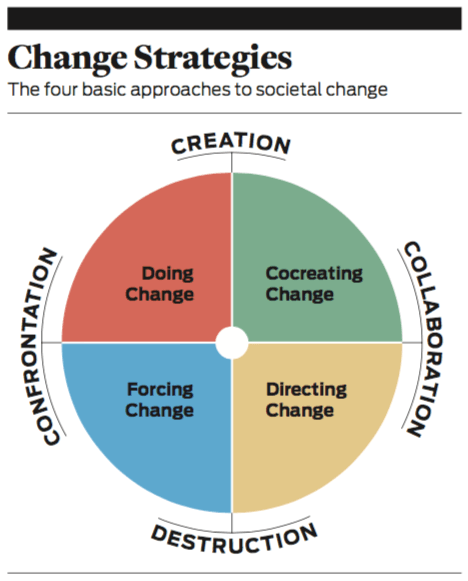
How do we transform a group of well-intended but collectively incoherent change initiatives into a powerful societal change system? The matrix serves as a device to raise valuable questions and spark insights for understanding change strategies or initiatives holistically. All change initiatives reflect some mix of the two dimensions. Although a particular change initiative may shift position within a quadrant as it evolves and its emphasis on particular dimensions changes, moving to a different quadrant would transform its core logic—its rationale, principles, and capacities.
To further explore this model, I also offer a table that describes each quadrant generically and then addresses our two examples of societal change. (See “Characteristics of Change Strategies” below.) Let us first examine each of the quadrants generically, then turn to the two cases.
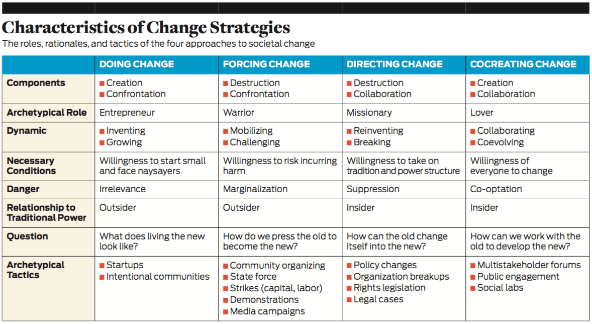
Doing Change: The Entrepreneurs | The upper-left quadrant is that of entrepreneurs who are out to create a new approach that defies the prevailing logic and ways of operating. This often takes the form of a social or commercial enterprise. The entrepreneur can be an individual, but for societal impact it is more often an organization or movement. Social innovation labs, Ashoka Fellows, and Impact Hubs all specialize in nurturing this type of activity. In business, this category covers entrepreneurs who are causing radical change, such as M-Kopa (providing solar energy in Kenya through innovative financing) and Revolution Foods (bringing healthy food to K-12 schools).
Entrepreneurs are not fixated on destroying the old, although that is typically the effect of their innovation. Their energy is devoted toward creating the new. These change agents usually face substantial skepticism and resistance by incumbents. This, problems with scaling, or simply the inadequate power of the invention may make the entrepreneurs unable on their own to bring about broad societal change.
Forcing Change: The Warriors | Activists as warriors are the archetype of the lower-left quadrant. They are the energy pushing for widespread change, trying to influence others through their pressure and advocacy. They must be willing to risk harm—perhaps only breaking windows, perhaps forcing a business to close and lay off workers, perhaps breaking the law. They focus on gathering strength through followers and supporters often associated with social movements. However, in the same way that social activists can attempt to force change through warrior-like tactics, capitalists can withdraw investment in the name of change, and governments can use the power of the state to incarcerate and fine resisters of change. The danger for this quadrant is failure to gather sufficient support and power to emerge from the margins—which leads some to become more violent and can even result in civil war.
Directing Change: The Missionaries | Those who are in positions of power and authority and are committed to change have a particularly challenging position. They can use that power and authority to secure change, but that often requires fundamental disruption in the structures that give them power and authority in the first place. They typically have a missionary’s zeal often associated with charisma for pursuing transformation, since such work involves overcoming immense inertia to break up and reinvent organizations and structures to become something very different. Their energy can easily be suppressed by status quo interests and skepticism that arise from trying to create something that no one has yet seen or experienced fully. Unilever CEO Paul Polman is an example of someone grappling with this change strategy to create a new business model that does not just do “less bad” but contributes positively to all aspects of society.
Cocreating Change: The Lovers | This is the popular but complicated strategy of “Let’s get all the stakeholders in the same room and figure out how we’ll work together for change.” It can be described as the “lover” strategy, because it is based on the proposition that people want the same thing and are willing to work together to get it. It depends on the willingness of everyone to change, since almost always every participant is part of a transformational problem—it’s not just others that have to change, but we all hold values, beliefs, and ways of understanding that have to change. Along the way, however, a more powerful or well-resourced stakeholder may induce others to settle for less change than is needed, resulting in co-optation.
The German Energy Transition
To illustrate these four archetypes of change at work, let us turn to Energiewende in Germany, the first of two case studies of largescale societal change that help to flesh out the model. The term “Energiewende” was introduced in 1980 by Germany’s Institute for Applied Ecology (Öko-Institut e.V.) as a call to abandon nuclear and petroleum-based energy. Translated as “energy transition,” it describes Germany’s commitment and ongoing transition to a sustainable energy future. In 2016, about a third of energy consumed in Germany came from renewables. (By contrast, about 15 percent of US energy consumption came from renewables, with a large amount of that from hydropower.) On one auspicious day in April 2017, Germany received a whopping 85 percent of its electricity from renewables. As a change challenge, the case is distinctive for the important role of technology.
In terms of change strategy, Energiewende illustrates the role of cocreation. Such an approach is part of the core post-World War II logic of Germany more broadly, as seen in joint labor-management boards for companies and in coalition governments. In the energy sphere, this approach was demonstrated in the 1980s with collaborative experimental work on alternative energy by the science, engineering, and industrial communities. Although there have been some shifts in strength, there has been broad support publicly for the change.
The ongoing collaborative approach must be understood in contrast to the United States: In Germany there is no oil and gas industry, so the main question was how to achieve sustainable energy technologically, financially, and pragmatically, by transitioning (destroying) traditional forms of power generation. Along the way, more widespread collaborative strategies for implementation have included broad public consultation and engagement around specific aspects of Energiewende, such as development of new transmission-line corridors.
This cocreation logic supported a directing-change approach reflected in 1991 national legislation called the Feed-In Tariff Act (FITS). It comprised two key elements: one requiring electric utilities to purchase electricity from renewable energy sources at minimum prices higher than the electricity’s real economic value, and the second requiring consumers to carry the financial burden.
This approach also supported a doing-change movement for energy transformation that pushed more decentralized energy generation. Farmers became solar and wind farmers, as well as agricultural producers; subsidies for solar panels led to widespread generation by homeowners. This doing-change activity became critical following the legislation, as a myriad of small producers of solar and wind energy arose. Individuals who earlier had thought of themselves simply as farmers or homeowners became energy producers as they installed wind turbines and solar panels. Individuals who were traditionally consumers combined energy production for sale through solar installations on their properties to become “prosumers.”
This has had wide-ranging implications for other directing-change actions, such as the decision in 2014 by Germany’s top utility, E.ON, to sell off (a form of “destruction”) its traditional coal and nuclear power businesses entirely, in order to focus on clean energy, power grids, and energy-efficiency services.
The distinctions among the four strategies can be blurred. For example, the city of Munich is working with the utility it owns to become, by 2025, the first city of more than a million residents to use 100 percent renewable energy. Given the city’s ownership of the utility, this can be seen as a directing-change strategy. But it also can be seen as a collaborative strategy, considering that it is a product of multiple stakeholder groups working with the producer and owner. And it is a doing-change strategy, considering that a geographic location has decided to simply go ahead and create the new system.
The energy transition is not occurring without resistance. But the main questions concern how to transition—with traditional energy generators and energy-intensive industries being the primary losers, who were largely bought off by the structure of FITS. As the new energy producers grew in number, they became key advocates for pushing ahead with the transition when it looked as if it might falter. Political mobilization was critical as a forcing-change strategy, leading to the Green Party joining a coalition government (1998-2005) that reinforced the original path with strengthened legislation in 2000. With local public utilities providing an important portion of the country’s energy, local elections also became periods of (re-en)forcing change with demonstrations and other actions to press forward with the energy transition.
Marriage Equality in the United States
In 2015, in an ultimate directing-change move, the US Supreme Court ruled that marriage between same-sex couples was a constitutionally protected right. Today 62 percent of Americans support it, according to the Pew Research Center. But only a half century earlier, every American state had laws that criminalized some form of same-sex sexual intimacy; until 1973 homosexuality was described as a “mental disorder” by the American Psychiatric Association; and in 1996 President Bill Clinton signed the Defense of Marriage Act, prohibiting same-sex marriage. The victory of marriage equality in the United States is arguably one of the most rapid changes ever for a core social institution and for fundamental values.
Perhaps predictably, given the very personal yet cultural quality of the issue and its US setting, the first challenges were by doing-change entrepreneurs. Individuals did not have to have someone “approve” their marriage to consider themselves married, and the United States has an individualistic tradition. Gays and lesbians simply lived as married couples, minus the legal recognition. In the 1980s, this increasingly became associated with commitment ceremonies of various forms, with those supportive of them present. Gay couples often brought children into their family from traditional marriages, through adoption, through surrogates, or simply through extended family. They became defiant role models.
On the streets, warriors took action by the public assertion of gay identity. In 1969, when policed applied routine harassment practices on homosexuals at the Stonewall Inn bar in New York City’s Greenwich Village, a riot ensued, and from this tiny, isolated protest a powerful gay rights movement grew. In 1979, between 75,000 and 125,000 individuals participated in the first national LGBT march on Washington, D.C. Gay parades became annual events in major cities, promoting gay pride and civil rights. In the 1980s, protests and aggressive actions were organized around the AIDS crisis. This experience provided a firm base for similar organizing tactics when the issue of marriage equality came to the fore in the 1990s. It became a dominant theme in the annual parades and fueled protests for legislative action.
Attempts to secure a directing-change strategy through legal rules started early. In 1970, the first legal challenge by a same-sex couple against the restriction of marriage rights to heterosexual couples was filed. The US Supreme Court dismissed it without a hearing. Gay activists took up the issue in the 1990s as the AIDS crisis forced more people out of the closet and more gays and lesbians decided they wanted the legal benefits associated with marriage. Eventually, legal victories piled up, beginning with arguments under state constitutions. In 1999, the Supreme Court of Vermont held that excluding same-sex couples from marriage was unconstitutional, prompting the legislature to create “civil unions” as marriages in all but name. The Massachusetts Supreme Judicial Court in 2003 issued the watershed ruling that made marriage between same-sex couples legal for the first time in an American jurisdiction. In 2012, voters in four states supported marriage equality through referenda—after 32 referenda had been lost around the country.
These victories built on cocreating change strategies of coalition building. Religious coalitions were especially important, given that opposition to same-sex marriage was often claimed on religious grounds as being against the will of God. At the turn of the millennium, the Religious Coalition for the Freedom to Marry in Massachusetts included more than 1,000 clergy, congregations, and organizations from 23 faith traditions. Lobbying in a warrior tradition grew into new coalitions cocreating change as Democratic Party leaders and legislators came on board.
In the background, a huge shift took place in business: By 2013, 67 percent of Fortune 500 companies offered health benefits for same-sex couples. The earliest significant examples were more experimental in a doing-it tradition, in industries that had a disproportionate number of gay employees and a more liberal workforce where employees could come out. There was a mix of concerns about fairness and ability to attract and retain employees. The early adopters gave way to a more directing-change strategy as businesses became convinced through lobbying and example setting that they should support their gay and lesbian employees.
The environment that led to this monumental shift was supported by a similar move by media companies. They started with a doing-change strategy of very occasionally bringing gay lives into popular entertainment. But this grew into a directing-change strategy, whereby the regularity of gays and gay marriage in popular entertainment became a message about what should be accepted as the new “normal.”
One of the first media breakthroughs on gay issues in general came in 1971 with an episode of the leading television sitcom All in the Family, which featured sympathetically two gay men. More direct issues of partnership, love, and commitment between two men were featured in the highly acclaimed 2005 hit movie Brokeback Mountain; the top-rated sitcom Modern Family, which premiered in 2009, included a gay couple with a child; and in 2012 Marvel Comics gave one of its superheroes a homosexual wedding, ensconcing it as a new norm to support.
Six Lessons of Societal Change
Applying the framework to the two cases not only helps to clarify the strategies and logic at work, but also offers more general insights about the process of societal transformation and the workings of societal change systems. Six lessons, in particular, stand out.
Each of the four strategies can contribute critically to one transformation. All four strategies play an essential role in both cases. The energy case provided individuals with a way to realize their ideals as prosumers, to advocate in various forums their beliefs and values, to develop collaborations with the existing system to create change, and to access power in institutions to support and direct the change. In the same-sex marriage case, doing change was reflected in individuals living as though they were married; forcing change provided a chance for supporters to demonstrate their position publicly; cocreating with early adopters such as supportive clergy provided important ways to pressure the establishment; and as supporters grew in legislative and judicial forums, they created a directing-change legal environment.
This suggests that the strategies are collectively important for providing a range of ways of supporting transformation, since different people and organizations have different roles in the change process. Property owners in Germany became doing-change leaders when they became prosumers; others supported the effort by being warrior activists. In the fight for marriage equality, only gay couples were capable of doing change, whereas non-couples and the broader community could participate in forcing change through demonstrations, parades, and referenda; cocreating-change efforts were particularly important for developing more sustained interactions among institutions that were early marriage-equality supporters; and the directing-change activity gave supporters a way to create change within their own institutions and in society more broadly.
Particular transformations emphasize a particular strategy. The four strategies were not of equal importance in the cases. For Energiewende, the directing-change legislative strategy was particularly important. Its salience arose in the context of broad agreement about the end, the value of the change, and the need to focus on the means to realize carbon-free energy. Under such circumstances, the ease of doing change through modest solar and wind energy commitments by individuals was also important; this group grew in power to become particularly strong advocates to offset the influence of resisters such as major industrial electricity users and private power companies.
The marriage-equality example makes more balanced use of all the strategies, although the directing-change action was the result. The doing-change strategy was critical for bringing gay relationships into the open and creating discussions among friends and family to challenge the traditional definition of family; forcing-change activities created space for a broadening number to express their support; building coalitions across traditional religious perspectives was critical to challenging religion’s role in the debate; but it was state legislation and finally the US Supreme Court rulings that were critical to ending the debate in the face of a still-divided public.
As a transformation progresses, the comparative importance of each strategy changes. Energiewende really took off with a cocreating-change strategy generated by broad support, which opened space for a shift to the directing-change legislative action. Legislation, in turn, enabled the doing-change strategy of individuals pursuing their own renewable energy production; forcing change provided secondary support for the overall transformation. In this case, all the strategies continue to interact as the transition continues.
Doing change was the original strategy for gay couples. But this was highly marginal, until the forcing-change activities associated with the assertion of lesbian and gay equality and demands for AIDS services created space for similar marriage-equality forcing-change activities. This produced directing-change actions first by some municipalities, states, and corporations, and eventually through the final resolution by the US Supreme Court.
The particular circumstances and environment that a transformation confronts determine the order of the strategies and their interaction. In our two cases, there is a notable diversity in stage order, and there is no obvious pattern. This suggests that characteristics of the cases themselves determine interactions between the strategies.
The most obvious question is why people do not simply start in an organic fashion, with the doing-change strategy growing into widespread adoption and a new dominant way of organizing and acting. This seems to have been the case for marriage equality. However, that case demonstrates that realizing an enabling environment for doing change usually first requires some forcing-change work. An important precursor to doing-change commitment ceremonies was elimination (or at least lack of enforcement) of laws against sex acts between members of the same sex. This required substantial forcing-change action by gay activists, although their efforts started with a desire to be left alone rather than to be married.
Qualities of the change issue itself can make a doing-change strategy on its own highly problematic. There were certainly early solar and wind energy entrepreneurs, but a doing-change Energiewende strategy was destined for irrelevance in the traditional operating environment, since developing technologies at scale requires substantial investment and change in rules governing energy transmission. However, in this case a cocreating strategy of collective education was the predominant predecessor of the creation of an enabling legal environment.
Therefore, there seems to be a dual lesson on strategy interaction: In permissive enabling environments, there can indeed be an organic change process that emphasizes doing change. These are environments where legal structures and norms provide the basis for, rather than impede, experimenting and innovating culturally, technologically, and philosophically. But in the absence of such an environment, forcing change is not the only strategy possible: Cocreating change can provide an important avenue if there is broad agreement that change is needed.
Enabling environments support experimentation and the creation of networks. The fourth lesson suggests important qualities of an enabling environment to ease transformation. There is particular value in structures and traditions that support exploration: the ability to try out new lifestyles, technologies, and values associated with transformations. Institutional rigidity, narrow definitions of what is acceptable, large interdependent structures where change requires complicated coordination, and weak processes for developing broad consensus about change directions all contribute to a brittleness that is associated with more problematic transformations, such as the United States’ transition to sustainable energy. Part of this is a question of political systems and the beliefs associated with them. Both cases involve political democracies. However, the multi-party German parliamentary system is more change friendly, as demonstrated by the important role of the Green Party. The range of options in the one-party Chinese system, for example, would be very different.
However, an enabling environment is not simply one of passive acceptance of diversity. The marriage-equality case demonstrates the importance of creating networks and adopting forcing-change strategies as well. The German case represents the importance of creating large-scale conversations and experimenting with transformational challenges to promote a cocreating-change strategy.
Each strategy requires distinct competencies. This article began by observing that different change organizations tend to be associated with different strategies. The cases illuminate the distinct tactics associated with each strategy, which in turn implies that they require different competencies. Experimenting with doing change is associated with entrepreneurial startup talent; forcing change emphasizes abilities to attract and organize mass numbers of people to take demonstrative action; cocreation focuses on facilitation and group-process skills; and directing change requires management, policy making, and enforcement capacity. This point about competencies further suggests that an organization is unlikely to be good at more than one strategy.
Yet, the two strategies build off each other. Sustainable energy, for example, can be seen not just as a technological question within the current power structures, but also as an opportunity to create more just and resilient societies. But within the latter, broader vision, negotiations are needed for how to get there. This also suggests the importance of one change initiative being able to hand off the change work to another.
Beyond Classification
This typology of change strategies promises far more than simply a system of classification. More important, it can inform an overall strategy of change for any particular issue in a societal change system. It can also guide the development of resilient societies, by illustrating the qualities that help address and resolve large change challenges.
This strategy analysis leads to important questions about processes for supporting productive interactions between strategies. For those working on change initiatives, the focus shifts from questions about how your initiative can be successful to how you can best serve the needs of the societal change system as a whole. Are there synergies, gaps, redundancies, or conflicts between your change initiative and others’ that should be addressed? The very concept of a societal change system suggests that whatever particular strategy your initiative adopts, there will be a need eventually to adapt to a cocreative strategy for the change system as a whole.